

Last year's results
Over the past three years BBC World has been featuring projects and businesses from around the globe that don’t sacrifice principles whilst making a profit. And each year we re-visit the previous year’s winners to see just how they’ve fared and what they’ve done with their prize money.

2006 WINNERS
Elephant Paper
A suprising ingredient in paper
helps protect the elephant in Sri Lanka


World Challenge has helped increase our sales to where demand is outstripping supply...Thusita Ranasinghe
2006 WINNERS
Elephant Paper
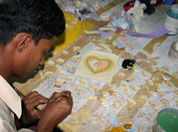
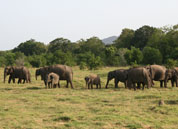
EcoMaximus is a papermaking firm that makes high-quality products from a variety of wastes, including paper from offices and bark from banana trees. The firm set up shop in Kegalle, Sri Lanka, in 1997, not far from an elephant orphanage. In Sri Lanka there is competition between elephants and a growing human population for land.
The proximity of elephants was a boon for the papermakers, for as they soon discovered, elephant dung is an ideal raw material for paper products. They began a range of elephant-dung paper to draw attention the plight of the Sri Lankan elephant. This unusual product has found buyers within Sri Lanka and throughout the world. A proportion of the sales are donated to the elephant orphanage. But elephants are not the only beneficiaries. EcoMaximus provided an income for 35 staff, and its recently established ‘Peace Paper’ scheme helps rural people earn money from collecting dung from wild elephants.
World Challenge reported last year the aim of Maximus’ founder is to establish a new factory an area where villagers and elephants are in conflict over land, forage and water. The new location is appropriate because the new settlements are right in the middle of an ancient elephant migratory corridor.
The challenge for Maximus will be to make the settlers on elephant land more tolerant of a four tonne pest. Providing employment for making the paper from locally collected wild elephant droppings, will help.
The new factory’s foundations are being laid. When it’s complete it will replicate the original production centre in Kegalle – on a bigger scale.
Thusita Ranasinghe from the project said:
“World Challenge has helped increase our sales to where demand is outstripping supply right now. So we hope to make this our main production centre. Within 3 to 6 months 150 people will be hopefully working here, exporting to the world market in the USA and Japan.”
The prize money we won from the World Challenge was used to partly buy a machine which is much stronger than the machines we were using before...Chris Page
2006 RUNNER UP
Card Aid
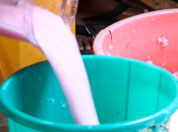
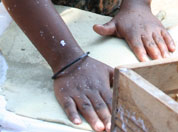
The scars of the Rwandan genocide that claimed some 800,000 victims will take a long time to heal. Communities throughout the country are struggling to deal with the legacy of unthinkable brutality. Families headed by orphaned teenagers, with sibling dependents, are commonplace. It was from a desire to help these survivors build a better life that British expatriate Chris Page and Rwandan artist Gariel Dusabe began Cards from Africa, a company that markets greetings cards made by a poor Rwandan community to shops around the world. The company began in 2004. Operating on a fair-trade basis, it provided a steady income for 40 young Rwandans.
The project was one of the runners up from World Challenge 2006. We caught up with Chris Page from the project who said:
“The World Challenge was a wonderful experience for us, our sales increased two or three times immediately. These sales came from about twenty new countries where we had received orders from. Puerto Rico, United Arab Emirates, New Zealand, Japan, across Europe and America.
The prize money we won from the World Challenge was used to partly buy a machine which is much stronger than the machines we were using before and also we were able to increase our publicity by going to two international stationary shows. At the New York Stationary show, one of the people we’ve been in touch with in the States came and volunteered for two days. We then decided we would work together and he would represent us in the States on a commission basis all sales made and that is where we are now. It’s an exciting stage for Cards for Africa and wouldn’t have been possible if we weren’t able to exhibit at the New York Show.
In 5 years we would love to be significantly bigger than we are now employing at least 300 – 400 vulnerable orphaned people in Rwanda. Our premises here is big enough for that and we want to be selling cards on a regular basis in at least 20 countries. The fact that we now have a programme that means sales reps and distributors can buy cards as well is very exciting for us.
If those needs and services continue month after month, year after year then those jobs are paying people month after month, year after year. And that’s true sustainability. It’s not dependent on the West and they are having the dignity of being independent and helping themselves and that’s what every poor person wants is - is that ability to fend for themselves and provide for themselves.”
this area is free from the grim grip of arsenicosis, as well as from the waterborne diseases, typhoid, amoebiosis, cholera...Sync Swapon
2006 RUNNER UP
Well Water
In Bangladesh, NGO Dalit, a small organisation dedicated to helping the Dalit or outcaste people, was one of the runners up in last year’s World Challenge awards.
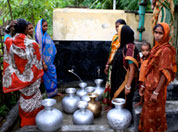
The contamination of the water supply in parts of Bangladesh and northern India with large quantities of arsenic has been described as the worst case of mass poisoning in recorded history. Long-term exposure to even small quantities of the poison can result in skin lesions, localised gangrene and eventually cancers of the skin, lungs, bladder and kidneys. Located in Khulna, Bangladesh, NGO Dalit is fighting the scourge of arsenic contamination by locating and tapping rare pure water sources by the installation of a deep tube well, designed to reach water below the arsenic-contaminated layer. A “deep” tube well goes down more than 45 metres, avoiding the concentration of arsenic lying between 25 to 40 metres. They also install filtration systems and researching herbal remedies for arsenic-related diseases. Last year, World Challenge visited the village of Salua with NGO Dalit, where a deep tube well failed to find arsenic free water. Here, NGO Dalit installed a pond filter, based on simple technology, to provide clean drinking water from a protected pond.
The NGO is named after the Hindu Dalit people who are discriminated against in Bangladeshi society and have suffered disproportionately from arsenic poisoning. This year, we returned to Salua to find out how being voted one of the winners of last year’s world challenge has changed things. Some of the $10,000 award went towards re excavating the pond here, providing clean water for 2000 families her and people from other villages too.
SYNC SWAPON from the project said:
“Now we re-excavated the ponds so more water is coming, when they are pumping, more water is coming and quickly they can fill their pots.
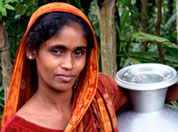
Last year it was between this... And then they re-excavated. Now it’s quite big. You know, when they are re-excavating, it is costly, so thank you for World Challenge that we can re excavated our ponds and many villagers they are coming here to take the nice water, drinking water. People from 10 to 12 kilometres come here to take drinking water and now people of this area is free from the grim grip of arsenicosis, as well as from the waterborne diseases, typhoid, amoebiosis, cholera and such and such.”
NGO Dalit is also reviving traditional herbal medicine which it claims can alleviate some symptoms of arsenic poisoning as well as other common ailments.
In this village, NGO Dalit has established a garden for plants that it claims have curative properties. In workshops, the villagers are taught how to use them.
It’s not finished yet... but we are assured the rest of the world challenge prize money is now being spent helping Swapon realise his dream of building a specialist lab for the preparation of ayurvedic remedies to international standards. It’s hoped the sale of traditional ayervedic remedies internationally will bring much needed funds for NGO Dalit to continue it’s work.


